The companies that struggle on Google Cloud aren't the ones who picked the wrong service. They're the ones who skipped the boring setup phase and went straight to building. The right first 90 days saves you from a foreseeable, painful re-platform six months in.
Here's the sequence we use when onboarding clients.
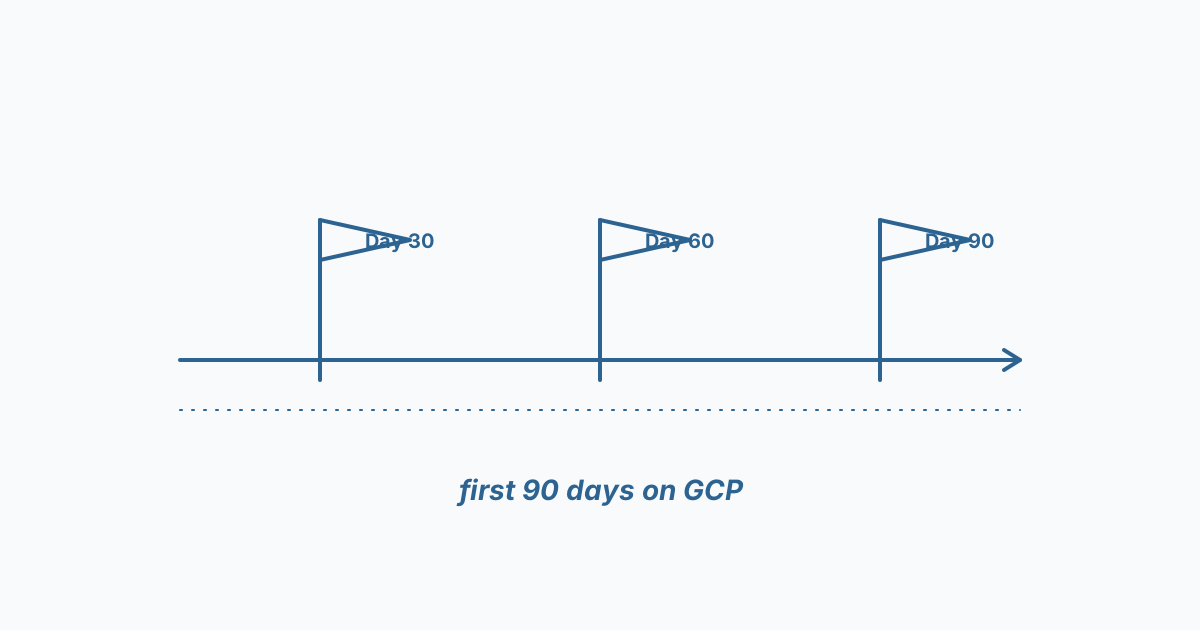
Days 1–14: Foundations
- Set up an organization, not a single project. Even if you have one workload today, the org hierarchy you create now is the one you'll live with. Folders by environment, projects by workload.
- Turn on org policies before anything ships. Region restriction, service account key creation disabled, public IP restriction on GCE.
- Wire up centralized logging and billing. One sink, one billing export to BigQuery, alerting on daily spend before week three.
- Identity from day one. Workspace or external IdP federated into Cloud IAM. No personal Google accounts touching production.
Two weeks. Skip this and you'll redo it in month nine, under stress.
Days 15–45: First workload, the right way
- Pick one real workload to move or build. Not a pilot — something that actually has users.
- Use Terraform from the first commit. Console clicks are how configuration drift starts.
- Deploy through a CI pipeline, not from a laptop. Even if it's just Cloud Build with three steps.
- Set up uptime checks and a dashboard before launch, not after.
The goal isn't to be impressive. It's to lock in the patterns the next ten workloads will follow.
Days 45–75: Operational muscle
- Run a real incident drill on the workload — kill a process, simulate a bad deploy. Find the gaps in your observability now.
- Tune the budget alerts. Most teams set them once and forget; they stop being useful after the first scale event.
- Document the "how to add a new service" runbook. If a new engineer can't ship a hello-world service end-to-end in their first week, the platform isn't ready for the second workload.
Days 75–90: Decide what's next
By day 90 you should have one production workload, a working CI/CD flow, real observability, and a team that can repeat the pattern. Now you can start moving the second and third workloads without re-inventing how you do cloud.
The teams that move fast on GCP six months later are the ones who spent these 90 days being deliberately boring. It's not flashy. It's just the difference between a platform and a pile of services.